• Stay Sharp. Be Cyber Bright.
  • https://www.youtube.com/@becyberbright
  • https://www.cybersafekids.ie/online-safety-jamaican-style/

CyberBright

~ Navigate Cyber Space in a Smart Way. Stay Sharp. Be CyberBright. Cyber Safety is a Human Right. You'll also find my ServeYouWrite blog entries: Health, Adventure, Travel, Humour, Food, Philosophy, Books & More!

CyberBright

Author Archives: becyberbright

One Part of a 50-Year-Old Woman’s Narrative is Not her Complete Story, nor Should it Render So Much Criticism; by Emma Sharp Dalton-Brown, May 12, 2026.

13 Wednesday May 2026

Posted by becyberbright in Life

≈ Leave a comment

Tags

Cyber Safety, digital-information, Education, Life, short-story, social-media, writing

When a 50-year-old woman posts a video of herself walking along a beach, while she is dressed in a swimsuit, there’s a backlash from a whole bunch of people. However, hundreds of younger women clad in carnival wear, dancing down the streets of Kingston, is celebrated. Some of these same young women display their bodies on their personal social media pages, with not a wrinkle nor a square inch of cellulite in sight. Sometimes they are pushing products that brands wish to sell to the followers of these “content creators”, other times they are doing it to get a particular brand’s attention. Often, these are beauty brands, so it is deemed acceptable when an attractive young lady uses her good looks and sex appeal to “sell” the merchandise. She may indeed be rewarded with some free merchandise herself, and with any luck she’ll also get paid. It’s not dissimilar to models or actors being hired by agencies of legacy media for their magazine and television advertisements, or even billboards.

Now, what would we think if a pretty 22-year-old woman was pushing her own products, essentially using herself as a model for her new business? Would we think it crass, inappropriate or “vaguely pornographic” if she was, let’s say, demonstrating the effects of her own skincare line on social media by wearing a swimsuit to show how beautiful her skin was looking? Highly unlikely. In fact, the criticism could well be placed on her youth, underestimating her ability to be successful at such a young age and possibly in part due to her gender. Don’t roll your eyes…..this is still a patriarchal society burdened by misogynistic archetypes.

What if the aforementioned 50-year-old is using herself to promote her carefully curated skincare brand on social media? It would mean she has to expose much of her skin for photos and videos. But why would she do that, you may ask? I’m potentially purchasing the product, aren’t I? Wouldn’t I need to see the results before I choose to buy? Is it really “vaguely pornographic” for her to show so much skin because she is 50? Should she have hired a 25-year-old model to demonstrate the results? That would be unhelpful, however, because all I’d be looking at is how the creams, serums and lotions affect the skin of a woman half my age. So, tell me, what should this intelligent entrepreneur have done? Oh wait, perhaps she should have hired a seasoned 50-something model like Naomi Campbell. Would you have judged Naomi so vehemently had she walked down a beach in a bikini, showing even more skin (Quelle horreur!)? I don’t even think you’d have had an issue with the supermodel Iman, a legend creeping up on 71 years old, had she posted a video of herself doing the same.

I just watched the 16th CARIMAC Aggrey Brown Distinguished Lecture in full, including the Q & A time, and I would emphatically encourage everyone to listen to what the guest lecturer, Lisa Hanna, had to say. While I do indeed have a personal interest in the issues she raised, it is essential for us all to acknowledge and ponder the changing world of digital media, the kinds of connections we are making with one another and the information we are absorbing. In my CyberBright cyber safety workshops and CyberBright Segments on Sunrise CVMTV, I have repeatedly discussed fake news, the differences between misinformation and disinformation, as well as imploring everyone to do the work to discover the whole story and not just make assumptions from the headline, an incomplete part of the story, nor, worse yet, the clickbait clip that’s gone viral.

Nine years ago, when I was 41, I wore a bikini on a beach. I didn’t have to post a picture online to get criticised for baring skin. I got assaulted in the flesh. However, I then posted a part of happened (no names mentioned), which gained a good amount of online support, but also some offline abuse. So, I went back to my social media page and posted the whole story, still not including any names. I garnered even more support, online and offline, but I still lost some friendships because those people had no interest in my entire story. Perhaps it didn’t suit their agenda or their view of me, who knows? But don’t for a minute believe that they did not fabricate their own stories about what happened, for their own social circles. These never went viral because, like I said, I never mentioned a word about who the predator was. You throw a stone into a pigpen and wait to hear which one squeals!

When you see a middle aged woman showing too much skin for your liking, you are influenced by your biases, but you are also swayed by the comments and an incomplete narrative that you have decided tells a complete truth. Your interpretation of a snippet of another person’s story is not the whole truth of the story, nor the person. Your understanding of an event is not the reality of the event when you have seen, heard or read about only a part of it. You cannot be truly analytical and critically thoughtful about anything, unless you have ALL the correct information. This article I’m writing now may incite much criticism and comments. You might even conjure up exactly the person you believe me to be, but it’s not my whole truth. One moment, one article, one video, one image of a 50-year-old woman in a swimsuit does not tell her complete story, nor should it render so much criticism.

emma@becyberbright.com

Share this:

  • Share on X (Opens in new window) X
  • Share on Facebook (Opens in new window) Facebook
  • Email a link to a friend (Opens in new window) Email
  • Print (Opens in new window) Print
  • Share on LinkedIn (Opens in new window) LinkedIn
  • Share on Reddit (Opens in new window) Reddit
  • Share on Tumblr (Opens in new window) Tumblr
  • Share on Pinterest (Opens in new window) Pinterest
Like Loading...

Are Vapid Influencers and Social Media Platforms Pushing Vapes on our Children?

08 Friday May 2026

Posted by becyberbright in Life

≈ Leave a comment

Tags

Cyber Safety, Education, Health, Life, Online Safety, smoking, vaping, writing

What would you do if you caught your kid vaping at home? Worse yet, what would you do if you received a call from your child’s school to say she/he had been found vaping in the bathroom?

But this is more than a “what if?”. While some of us may be sure that our daughters and sons do not smoke, nor vape, because we parents clean the backpacks, do the laundry, tidy the bedrooms, etc, we have no way of knowing, with absolute certainty, that they have not been offered it at school (and tried one “puff”, or even more). I do not like to be the parent who says, “My child would never……”, because, truthfully, I do not want to be the fool who is naive enough to believe that even the most well-behaved children won’t sneak around and do something of which their parents would not approve! It happens. Heck, weren’t we teenagers once?! In fact, one day during the summer holiday one of my brother’s and I (we were 15 and almost 13 years old), along with a few friends, took a bottle of liquor from the cabinet and hid it. After our parents went to bed, we went to get the bottle and it had gone. WHAT!! WHO could have taken it? Well, we had our answer the next day, when the cabinet was opened by my mum and there it was. She never said a single word to us…..until years and years later, when we all had a good giggle about it. Our parents believed in allowing us to take a couple sips of wine or beer when we were that age, but under their supervision. It did not mean we could stash a bottle of vodka behind a bush and drink the entire thing with our friends in the secrecy of the night! Parents used to know everything, but it simply is not the case nowadays. Social media and personal electronic devices have made that the certainty!

I suspect that our mum heard us discussing our plot to deceive because conversations were had face to face or on a landline. There was no private texting on Snapchat, WhatsApp, or the like. Our conversations with our friends were essentially “public” within the house. Nowadays, all kinds of plotting and planning can occur without us knowing, and while there is a chance you may be home to monitor what your children are doing, there are tiny windows of opportunity at school, larger ones at parties and perhaps at someone’s house if those children are not supervised. As for teenagers, adults tend to leave them to their own devices (pardon the pun) as they get older.

Recognising that the covert texting is occurring, where on earth are these kids getting the idea to start vaping? Some may be learning from their peers, but it’s a real and broadly spread issue, so what has been the root cause and the catalyst of why there are so many teenagers, and even pre-teens, who vape? Marketing…..but not the traditional marketing to which we were exposed when we were young. There’s a new kind, one which we don’t even realise is causing a huge problem as we are literally not seeing it. Social media is the most influential marketing tool for any product one wishes to push on children, and they don’t even have to go searching for it. The algorithms are set to advertise any product that will pull your teenagers and young children in to keep scrolling.

“I don’t see any ads on my social media feeds about vaping,” some of you may say. For the record, I don’t either. But it is clear from my age and my interests that it is unlikely that my algorithm would bring such ads to my feeds. Indeed, it doesn’t even need to be an interest of your child to show up on his or her feeds. And if they are not seeing actual advertisements, they are watching and/or following social media influencers and content creators (all rather boring sets of people), who either use e-cigarettes and/or are being paid to “use” them and put them in their online content. Ironic, considering the legal age here in Jamaica (and many other countries) to purchase and use any vaping products is 18 years old. Some states in the USA require you to be 21 years old. So why is it that online ads are being pushed by social media platforms to the screens of teens? Nothing like the bottomline of wishing to generate billions of dollars! This is what we are battling with, my friends, and there is only one way for this war on e-cigarettes to end. We must keep pushing for legislators to make these big tech, social media companies put the safety of our children above all else. There has to be real consequences for these companies, with criminal charges that include heavy fines and imprisonment.

Listen, 75 years ago it was deemed acceptable to advertise cigarettes on national television and radio, until it was banned 20 years later. E-cigarette ads have been running for 12-14 years, with a rapid increase in online ads of all vaping products in the last 8 years. Yes, just before Covid started, restrictions were technically put in place by Meta to prevent influencers from promoting the use of branded vaping paraphernalia, but this has not stopped them, with Instagram and TikTok being two of the biggest culprits. What are two extremely popular social media platforms for teenagers? Instagram and TikTok. I also want to note that while both these platforms have a legally required age of 13 years old for users (16 years old in some countries), many children as young as 10 years old have accounts, because all they need to do is lie about their age. And do not fool yourselves, many of you know that your underage child uses these platforms. They may tell you that they’re only looking at music videos, or sports-related content, or “that’s how my friends communicate,” or they may even insist that it’s social suicide NOT to have Instagram, TikTok and Snapchat, but I can promise you, from personal experience it is NOT social suicide. Please do not let your children use these platforms and hold off until they are at least 15 or 16 years old. I promise you, you will not regret it. No future adult will ever look back and say they wished they had been on social media when they were a child or young teen! These greedy social media platforms do not have your child’s best interest in mind and the influencers that “everyone” is talking about are vapid and just as greedy as the soapbox upon which they stand.

Emma@becyberbright.com

For information on the harm e-cigarettes and vaping causes, please read this paper published in the National Library of Medicine: Electronic Cigarette Harms: Aggregate Evidence Shows Damage to Biological Systems

Please also check out the American Lung Institution’s The Impact of E-Cigarettes on the Lung

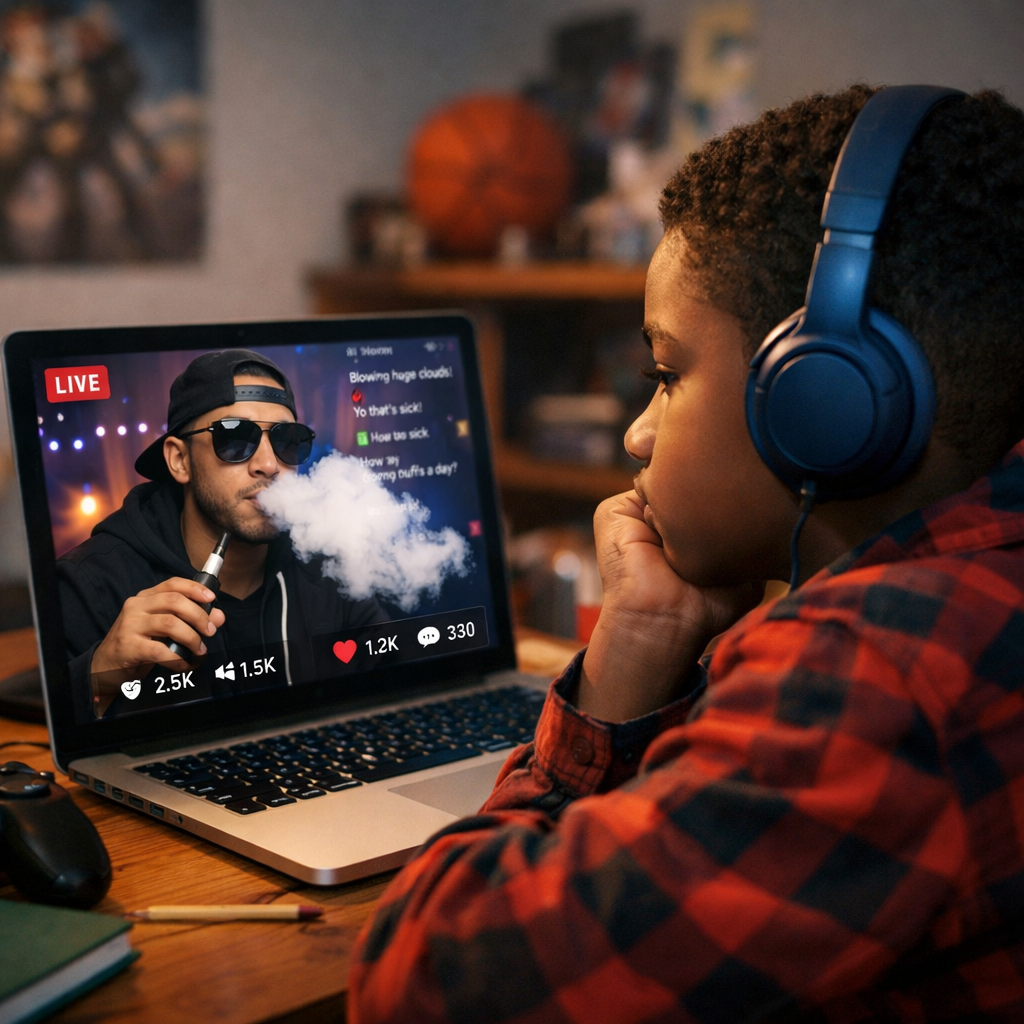
A boy wearing headphones watching a livestream of a man vaping on a laptop screen
A young boy watches a live vaping stream on his laptop.

Share this:

  • Share on X (Opens in new window) X
  • Share on Facebook (Opens in new window) Facebook
  • Email a link to a friend (Opens in new window) Email
  • Print (Opens in new window) Print
  • Share on LinkedIn (Opens in new window) LinkedIn
  • Share on Reddit (Opens in new window) Reddit
  • Share on Tumblr (Opens in new window) Tumblr
  • Share on Pinterest (Opens in new window) Pinterest
Like Loading...

Life is “Lifing” in the Dawkins’ Dramedy ‘A Rose of Sharon’ Written by Emma Sharp Dalton-Brown, May 4, 2026.

05 Tuesday May 2026

Posted by becyberbright in Life

≈ Leave a comment

Tags

fiction, plays, review, reviews, theater, theatre, writing

There are few plays that have you spontaneously belly-laughing with such ease, almost dropping off your chair, while simultaneously seated in the discomfort of a truth that is known and felt by, likely, an entire Jamaican audience. ‘A Rose of Sharon’, written by Basil Dawkins and directed by his daughter TK Dawkins, is one such Dramedy.

I rarely read much about a production before seeing it, believing in the adage “show, don’t tell”, because I want to sense what the universe has laid out for me in real time, without someone else’s opinion influencing my own. Now here I am writing to tell you what I thought about the play, not really to make those of you who have not seen it envious (but you should be!), but rather to absorb the life-harrowing elements underlining the script.

In a nutshell, Basil Dawkins has written a play about a lady road sweeper who takes in a deportee on the bone of his backside, at the risk of upsetting her son. What a simplistic storyline, right? Don’t make assumptions……How could this possibly go deeper than it sounds? Keep reading….How could three actors show the audience a full understanding of the lives their portrayed characters have experienced and are still experiencing? Allow me to illustrate.

Beginning on the backstreets of Kingston, street-cleaner Vida bucks up a down and out man, Fahrenah, who has recently been detained by ICE and deported from the United States. He is a shell of who he once probably was, cowering under the confidence of Vida, who is intent on calling him “husband” as soon as she gets home to her son, Tall Man. But Tall Man, a delightfully amicable young rasta who is very small in stature, but big in presence, shows Fahrenah what he really thinks of him, making no attempt to curb his raw Jamaican patois so that this foreigner can actually understand him.

As dialogue unfolds between the two gentlemen, their use of the stage and the props permit us to truly absorb the set. Vida has created a home in a gully, literally under a bridge, for herself and Tall Man. The cut stone wall has a beauty about it, reminiscent of somewhere peaceful in the countryside, but we are jolted back to reality when we notice that Vida has used someone else’s tossed out tarpaulin and rusty zinc to create partitions within the “rooms” of her “house”, which is fronted by an enduring wall of disposable plastic bottles. Terrific touch, TK, lest we forget that we must each make the effort to ensure a greener environment for everyone on earth. Rather fitting with a script whose main character likes to keep the streets clean!

Award-winning actress Deon Silvera succinctly demonstrates Vida’s lifetime (thus far) in less than two hours. Sure, much of this is depicted in her lengthy monodrama lines, but she still has us hooked with her ability to exhibit the multiple people and events, which were placed along her path, in those monologues. Ironically, Silvera has the audience howling with hilarity and bursting with uninvited and bold-faced comments, all due to her talented delivery of her story, as the misfortune and hardship in Vida’s life is hardly comedic.

Indeed, Vida’s curated family, Fahrenah (Dennis Titus), who repeatedly reflects on his own family, and Tall Man (Derrick Clarke), who was abandoned by his mentally ill biological mother, yet still makes gestures to care for her, both also manage to mask the underlying heaviness of their situations. And the audience on Saturday night ate it all up, unable to stop the laughter, even for a moment to acknowledge the characters’ tragedies. Make no mistake, while we all bellowed, it was not lost on me (and others I am sure) the denial playing out in each of our psyches. This is Life’s life. (See what Basil Dawkins did there!)

In case those of you who have not seen this play will get to watch it one day, perhaps Mother’s Day I hear, I won’t give away any more of this rich story. But I will take my leave with a few last words……

As we applauded the three-people cast, the director, the playwright, and every other person involved in this near-perfect production, a part of me yearns to know what happens to Vida, Fahrenah and Tall Man after the script ends, because their stories are not over. Does Vida stay living under the bridge? Should we be concerned about her? Vida, meaning Life in Spanish, and her utter abandon to her god, makes you wonder if she is even worried. Vida is simply “lifing”.

emma@becyberbright.com

Pink hibiscus flower with red center and green leaves
A Rose of Sharon

Share this:

  • Share on X (Opens in new window) X
  • Share on Facebook (Opens in new window) Facebook
  • Email a link to a friend (Opens in new window) Email
  • Print (Opens in new window) Print
  • Share on LinkedIn (Opens in new window) LinkedIn
  • Share on Reddit (Opens in new window) Reddit
  • Share on Tumblr (Opens in new window) Tumblr
  • Share on Pinterest (Opens in new window) Pinterest
Like Loading...

The Pitfalls of Reels & Videos (TikTok & YouTube): Emma’s Mini Cyber Safety Workshop #2 on Sunrise CVMTV. Stay Sharp. #BeCyberBright

24 Saturday May 2025

Posted by becyberbright in Life

≈ Leave a comment

Share this:

  • Share on X (Opens in new window) X
  • Share on Facebook (Opens in new window) Facebook
  • Email a link to a friend (Opens in new window) Email
  • Print (Opens in new window) Print
  • Share on LinkedIn (Opens in new window) LinkedIn
  • Share on Reddit (Opens in new window) Reddit
  • Share on Tumblr (Opens in new window) Tumblr
  • Share on Pinterest (Opens in new window) Pinterest
Like Loading...

A Child’s Right to Online (Cyber) Safety. Stay Sharp. Be CyberBright.

21 Wednesday May 2025

Posted by becyberbright in Life

≈ Leave a comment

Tags

becyberbright, Children, Cyber Safety, Education, mental-health, parenting, social-media, technology

“Your child does NOT have the right to be fed, clothed, housed and educated, nor does your child have the right to safety,” said no-one!

What if parents agreed with this notion, however? You would be appalled, correct?

How many of you parents make it your business to keep your child safe online at all times? How many of you have put in parental controls limiting device-use time and setting “downtime” hours on all devices, as well as blocking certain apps or limiting time spent on particular apps? Have you talked to your children about the potential dangers they might face online? Does your child share his or her location with any app or website? Is your child’s phone/device contact list shared with apps such as Instagram or Snapchat? What personal information does your child share on their social media platforms? Does your child share hobbies or the sports played, the school he or she attends, photos of your house, or even where your family is currently on vacation? Have you vetted every single one of their “friends” or followers online? Do you allow your child to play online games with people they have never actually met in person? Does the online game, which your child is playing, facilitate chatting with strangers, text or voice, and have you put the settings to disable this feature? Does your child go on YouTube? Do you know the content of every single video your child has watched or is watching? Does your child ever watch TikTok reels or videos? Are you aware of the content TikTok feeds to your child in the “suggested for you” feed? Have you read RTÉ Prime Time Experiment reveals disturbing content recommended to 13 year old Tik Tok users? Do you check your child’s phone regularly to ensure that he or she is not exposed to any inappropriate content, via any website or app, including communication with people he or she does know? Do you allow your child to take his or her device into a bedroom or private space with the door closed? Do you allow your child to have any device in the bedroom overnight?

If you read the United Nations Convention on the Rights of Children, which contains 54 Articles in total, you will find several Articles that could arguably include a child’s right to cyber safety (online safety). Article 17, in particular, bears the language that puts the onus on us, as the adults, to ensure that the information children get online is not harmful. “Children have the right to get information from the Internet, radio, television, newspapers, books and other sources. Adults should make sure the information they are getting is not harmful. Governments should encourage the media to share information from lots of different sources, in languages that all children can understand.” Convention on the Rights of Children – Child Friendly Version

In Article 34 of the aforementioned, it explicitly insists “The government should protect children from sexual exploitation (being taken advantage of) and sexual abuse, including by people forcing children to have sex for money, or making sexual pictures or films of them.”

Surely children should equally be protected from online sexual exploitation, such as cyber grooming, both by strangers and people they know.

Oh, wait! The Convention on the Rights of Children – Child Friendly Version does technically have a blanket cover for every single form of exploitation, as depicted in Article 38: “Children have the right to be protected from all other kinds of exploitation (being taken advantage of), even if these are not specifically mentioned in this Convention.”

I know that this all sounds incredibly daunting and time consuming. How on earth are we, as parents, expected to monitor our child’s every move online? Don’t you know we have jobs and homes to look after? We have to worry about feeding our families and paying the bills, as well as ensuring that our children do their homework. Simply put, we are not with our children 24 hours a day. This, however, does not exempt us from the obvious responsibility, in all matters, which we have for our children, whose lives are very much entwined with the online world. Thus, we must make every effort to set aside the time to educate ourselves and put parameters in place when it comes to our children’s online presence. Remember if your child has access to the world online, then the world has access to your child. The cyber world is not a game of “let’s play pretend”, but rather, real life on steroids. Within seconds, a message, a post, an image or a video can be shared and go viral, or within minutes your child could be exposed to inappropriate content and exploitation.

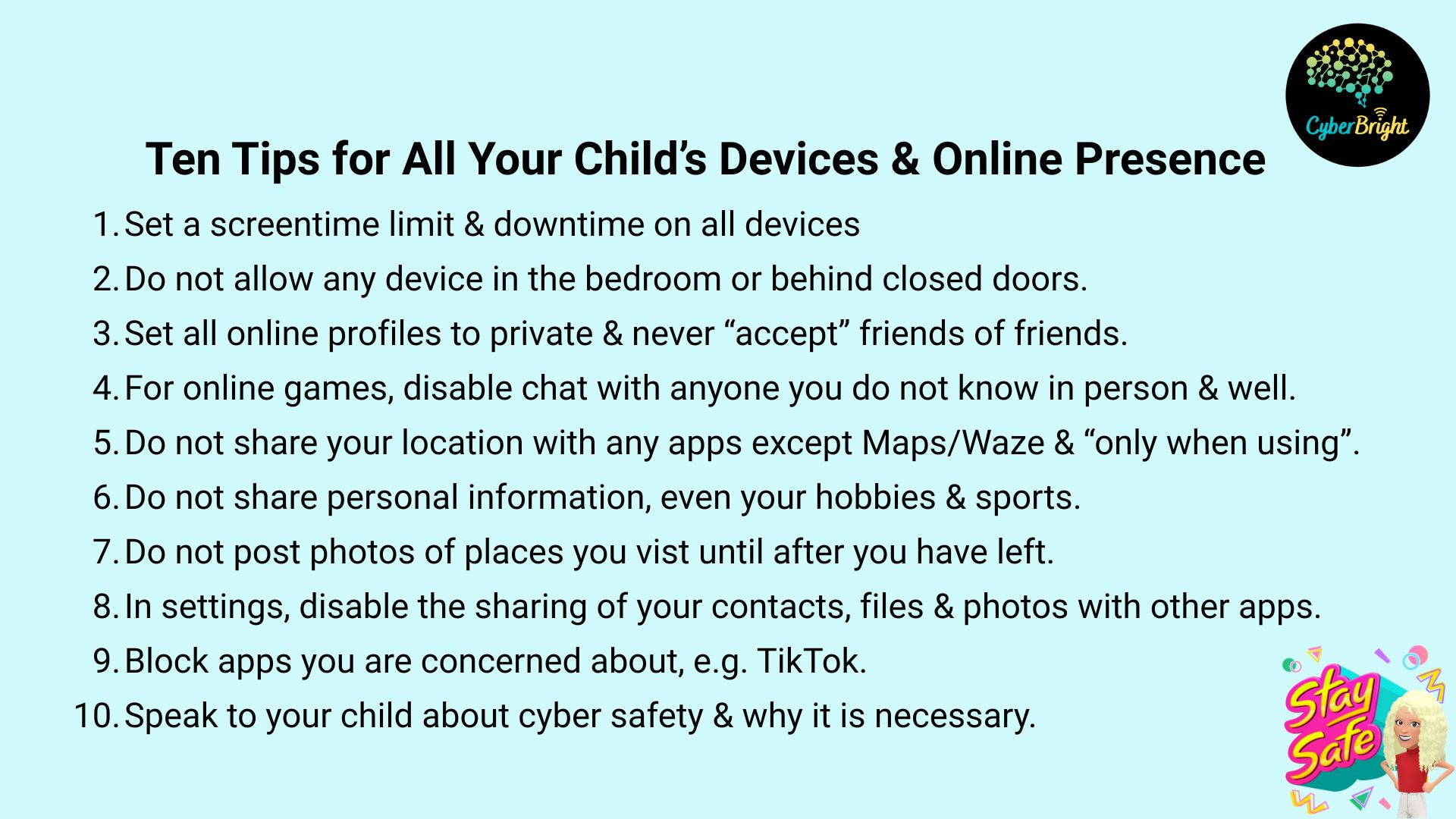
Drawing from my own screen-time rules, which have morphed over the years from allowing certain cartoons on Apple TV or NickJr and Disney movies on DVDs, to safeguarding my children’s current online exposure as best as possible, and of course pulling from my mentors at CyberSafeKids, I do have ten tips to get you started. (see attached)

The truth is, even the rules and parameters that I place on myself have changed, as each day I am still learning more ways to safeguard myself, my family and my friends. And while it is imperative for me to protect my own children, there is an overwhelming need for all children to be protected online. For those of us who can be a part of this, we must do so. For this to be effective in every way, all adults need to learn about cyber safety. If we want children to buy into the idea that cyber safety is essential, adults have to buy into the same. In order for all adults to get on board, clear and stringent cyber safety laws should be put in place here in Jamaica. While there is a supposed to be a National Child Online Protection Committee, I do feel very strongly that there should be a specific “Child’s Right to Online Safety” Act. That said, for this to be executed and enforced, cyber safety awareness must be simultaneously brought to all Jamaicans through our education system and through media in a collaborative effort. So, a big shout out and my gratitude to Sunrise CVMTV for beginning to get on board with me at CyberBright.

Stay Sharp and #BeCyberBright.

emma@becyberbright.com

Share this:

  • Share on X (Opens in new window) X
  • Share on Facebook (Opens in new window) Facebook
  • Email a link to a friend (Opens in new window) Email
  • Print (Opens in new window) Print
  • Share on LinkedIn (Opens in new window) LinkedIn
  • Share on Reddit (Opens in new window) Reddit
  • Share on Tumblr (Opens in new window) Tumblr
  • Share on Pinterest (Opens in new window) Pinterest
Like Loading...

Sharing Personal Information & Location Online: Emma’s Mini Cyber Safety Workshop #1 on Sunrise CVMTV Stay Sharp. #BeCyberBright

20 Tuesday May 2025

Posted by becyberbright in Life

≈ Leave a comment

Share this:

  • Share on X (Opens in new window) X
  • Share on Facebook (Opens in new window) Facebook
  • Email a link to a friend (Opens in new window) Email
  • Print (Opens in new window) Print
  • Share on LinkedIn (Opens in new window) LinkedIn
  • Share on Reddit (Opens in new window) Reddit
  • Share on Tumblr (Opens in new window) Tumblr
  • Share on Pinterest (Opens in new window) Pinterest
Like Loading...

Care What You Share: Be CyberBright about Sharing Personal Information & Location

11 Sunday May 2025

Posted by becyberbright in Life

≈ Leave a comment

Tags

parenting, social-media, technology

Too often we easily share our personal information online – the sports in which we participate, the football clubs we support, our hobbies, our trips, our dreams and even information about our children. We might not explicitly write what any of these are, but by posting photos, we are revealing so much about our lives. Even if our social media accounts, like Instagram, are set to private, any number of our friends or followers could screenshot a photo and share with whomever they please. If you have 500 followers, all 500 of them could potentially screenshot and share your photos. But the truth is, it only takes one follower to do this and then it’s out of even their control. Who is to say with whom they will share and with whom the next person will share, and so on?!

Can you imagine if you printed out each of your photos you have ever posted on Instagram, as a post or a story, 500 times and handed each photo to 500 people Down Town, or anywhere for that matter! These 500 people would think you were very strange for doing this and, frankly, the whole exercise would seem rather creepy. It would also be highly unlikely for any of these 500 people to make copies of your photos and hand them out to others. So, why are we comfortable sharing the same photos with the 500 followers online? Please take note: Online life is real life on steroids.

Let’s now look at location sharing.

Apps and websites often ask us, in the form of a pop-up box, if we would like to share our location. It happens so fast that it is very easy to “allow”, especially as we may be focusing our attention on what we want or need from the app or website itself, thus not reading the pop-up box properly and clicking on it just to eliminate it from our screen. You know it happens! In fact, some people think that sharing location is harmless and may have benefits.

Teenagers are especially prone to easily sharing their location. Take Snapchat, for example, which has Snap Map. “Snap Map lets you discover fun places, see what your friends are up to, and view Snaps from the community.” https://help.snapchat.com/hc/en-us/sections/5689786363284-Snap-Map If you choose to share your location, this information is also revealed about you to all your “friends” on Snapchat. Once again, your “friends” can screenshot your location and share with whomever they choose. Moreover, you may not actually know all your “friends”. It is quite common for teenagers to allow “friends” of “friends” to follow them. It is also quite common for none of them to know who indeed some of these “friends” of “friends” are, no matter how far back they might try to trace them. In reality, these “friends” of “friends” are in fact strangers, potentially predators.

Your teenager is out with his or her friends at the movies, followed by dinner in the food court, let’s say. Everyone, except your teen, wants to go to the ATM and your child agrees to watch their backpacks while they go for cash. Minutes later, someone comes up to your child and introduces himself as “Michael”, explaining that he is a friend of some of the close friends in the group. He says he was supposed to meet them for dinner after the movies, he names the friends, he indicates where they all go to school and live, what mode of transport they take, where each friends went yesterday, last weekend, and so much detailed information about their movements over the last few months, or even year, that your child has enough proof that Michael is legitimately a close friend of some of the friend group. Michael gets a phone call, then tells your teen that one of the friends, Peter, at the ATM, is asking them to bring their bags up to the carpark. Off your teenager goes to the carpark, with Michael and all the bags, to meet Peter and the others. They get to the carpark, “Michael” has a gang waiting for your child, from whom they and Michael steal all the bags, along with your child’s phone and wallet. Predators will go to great lengths to learn yours and your friends’ patterns online. Snap Map facilitates this predatory behaviour.

The truth is, it is not a necessity to share your location online. Now, you may need it when using Google Maps or Waze, but ensure that in your phone settings you select “only while using”, then properly scroll out of said app as soon as you have finished using it. You may even have an app like Life360 with your immediate family, but make sure you are only sharing your location with said immediate family. Otherwise, why do you need to share your location? You do not. Stay Sharp. #BeCyberBright

emma@becyberbright.com

Share this:

  • Share on X (Opens in new window) X
  • Share on Facebook (Opens in new window) Facebook
  • Email a link to a friend (Opens in new window) Email
  • Print (Opens in new window) Print
  • Share on LinkedIn (Opens in new window) LinkedIn
  • Share on Reddit (Opens in new window) Reddit
  • Share on Tumblr (Opens in new window) Tumblr
  • Share on Pinterest (Opens in new window) Pinterest
Like Loading...

An Overview of Cyber Safety for Children & Adults: Be CyberBright on Sunrise CVM TV

26 Saturday Apr 2025

Posted by becyberbright in Life

≈ Leave a comment

Share this:

  • Share on X (Opens in new window) X
  • Share on Facebook (Opens in new window) Facebook
  • Email a link to a friend (Opens in new window) Email
  • Print (Opens in new window) Print
  • Share on LinkedIn (Opens in new window) LinkedIn
  • Share on Reddit (Opens in new window) Reddit
  • Share on Tumblr (Opens in new window) Tumblr
  • Share on Pinterest (Opens in new window) Pinterest
Like Loading...

Stay Sharp. Be Cyber Bright.

21 Monday Apr 2025

Posted by becyberbright in Life

≈ 2 Comments

Tags

Children, Cyber Safety, cyber-bullying, cyber-grooming, Education, jamaica, mental-health, online, schools, sextortion, well-being

Imagine your 12 year old daughter committing suicide because she had been sexually abused and blackmailed by a man who had catfished her, originally pretending he was a girl her age named ‘Sarah’. This is what happened in 2018 to 12 year old American, Cimarron Thomas, who lived with her parents and siblings.

“Using a fake persona, (Alexander) McCartney contacted her (Cimarron Thomas) online, complimented her on her appearance, and began grooming her before she sent him an intimate photo. The court heard that during the first abusive interaction, he kept her online for an hour and 45 minutes, demanding sexual and degrading images. He told her if she didn’t send him more photos, he’d publish the ones he already had on the internet. Cimarron went back to school and did not tell anyone about the abuse. McCartney continued to pursue Cimarron and contacted her four days later using another fake account, saying: “I want to play one more time.” Despite pleading for McCartney to stop and being visibly upset, he told her to “dry your eyes” and involve her younger sister, aged nine, in a sex act. Cimarron refused and said she would rather kill herself. McCartney then put up a countdown clock, telling her “goodbye and good luck”. Three minutes later, Cimarron was found by her nine-year-old sister, who entered the room after she thought she heard a balloon pop. She had shot herself in the head with the family’s legally-held firearm. Cimarron was taken to hospital where she was pronounced dead. Her family had no idea why she had taken her life and were unaware of the ordeal she had been subjected to. Her mother, Stephanie, told investigators that she might have been unsure of her sexuality. Eighteen months later, Cimarron’s father then took his own life. However, years later, the truth behind what had happened to Cimarron emerged.” https://www.bbc.com/news/articles/cm2yj24xge1o

Thanks to the bravery of a 13 year old girl from Scotland, who spoke up after being catfished by the same university student, Alexander McCartney, authorities were able to capture, arrest, convict and jail him for at least 20 years.

“Alexander McCartney from Northern Ireland pretended to be a teenage girl to befriend, then abuse and blackmail children around the world, often sharing images with other paedophiles. Some of the children were as young as four. Some had never told anyone what they had been through – until police knocked on their door. McCartney gradually admitted 185 charges including manslaughter after a 12-year-old girl he was abusing took her own life.” https://www.bbc.com/news/articles/crejr8grr01o

As if the thought is too much to stomach, and I apologise to anyone who may be triggered by these harrowing facts, I believe it is imperative that all parents read about and pay attention to the horrors happening across the world and understand that our children are not necessarily safe in their bedrooms on their devices – phones, laptops, iPads and any other electronic tablets/devices that can be connected to the internet.

“McCartney’s crimes occurred between 2014 and 2019, when he’s believed by police to have targeted about 3,500 victims, mostly via Snapchat, all over the world, including in Australia, New Zealand and the U.S., according to the Press Association. The case against him in the Belfast Crown Court focused on 70 child victims, including (Cimarron) Thomas.” https://www.cbsnews.com/news/catfishing-alexander-maccartney-sentenced-us-girl-cimarron-thomas-suicide/

Young girls are not the only demographic at risk – our boys are being targeted as well, notably through ‘sextortion’ by online criminals pretending to be pretty young girls attracted to them. Three particular cases, which have been in the media in the USA, come to mind. These involve 15 year old Braden Markus, who died by suicide in 2021 within 30 minutes of being ‘sextorted’ online, and James Woods and Jordon DeMay, both 17 years olds when they each committed suicide in 2022, also after being ‘sextorted’.

“When police looked through James’ phone, they discovered he had fallen victim to financial sextortion, a crime that occurs when a predator threatens to distribute private material or harm a victim if they don’t comply with the predator’s financial demands. The scam is the fastest-growing cybercrime targeting children in North America and most commonly exploits young men, particularly boys ages 13 to 17. Sextortion has been connected to at least 30 deaths of teen boys by suicide since 2021, according to a tally of private cases and the latest FBI numbers from cybersecurity experts………The teenage girl who messaged him (Jordan DeMay) was really a group of cybercriminals that included Samuel Ogoshi and Samson Ogoshi, Nigerian brothers who in September 2024 were sentenced to 17½ years in prison and extradited to the U.S. The group of predators targeted Jordan and more than 100 others, including at least 11 minors.” https://www.usatoday.com/story/life/health-wellness/2025/02/25/teenage-boys-mental-health-suicide-sextortion-scams/78258882007/

The truth is, even people whom our children and we know can become predators in the form of scamming or sexual grooming. That said, there are many wonderful and fun aspects of the internet that have become daily common-use and necessary for work, learning, socialising and gaming for adults and children alike.

Most people do not realise the real dangers of privacy invasion and scams, which can lead to compromising your WhatsApp messages, the contacts stored in your phone, your personal and business files, your bank account information, and even access to your online shopping sites such as Amazon and other apps where money is at stake. Moreover, the risks posed by believing and further spreading fake news, as well as inappropriate content exposure, sexual grooming, sexual harassment and other acts of cyberbullying can affect all ages, including adults. Many children, especially teenagers, have little to no cyber-supervision and the adults in children’s lives don’t fully understand the extent to which they could fall prey because they, the adults, are also victims of online manipulation and abuse. 

Moreover, we can pay a high price when it comes to our digital footprint, as every time we post anything online, it becomes part of our digital footprint. Everything we do online stays online forever. If we delete it, someone could have screenshot and saved it already. Every “like”, comment, search, video watched, music listened to, and so on, all leave a digital footprint. What we do online today can affect our current positions at work and any job applications in the future. Our digital footprint must be a positive one.

Children must especially take note as schools, colleges and universities all look for social media presence of their applicants. Your past can come back to haunt you, so unless would not have a problem if something you have posted/commented on/done online were to be published on the front page of the newspaper, do not do it. Not to say you’d want what you share/post to be published in the paper, but you must be okay with it if it is. Like I tell the teenagers and young children to whom I give cyber safety workshops, “The online world is the real world on steroids.”

Which leads me to the cyber safety workshops themselves. In 2020, soon after the Covid pandemic began, I was trained as a trainer in Cyber safety by CyberSafe Ireland, now called CyberSafe Kids, https://www.cybersafekids.ie/, after which I designed an interactive Cyber Safety programme to help students, their teachers and their parents. I launched my online Cyber Safety workshops in April 2021 and by October 2021, I had reached 1400 students, teachers and parents from rural community schools in Westmoreland, Hanover and St. Mary in Jamaica.

After a long hiatus doing other projects, I saw that the need for literacy in social media and online use in general was rising exponentially, so I relaunched my cyber safety programme under the name CyberBright. In May 2024, I brought my workshops to 700 students in 21 class groups at Campion College and in February/March 2025, I taught another 550 students in 19 class groups at Campion. In September 2024, I also gave a workshop to students of Ph.D. Clinical Psychologist Dr. Tracey-Ann Coley doing their Masters in Psychology at University of the West Indies, so they might be able to use the knowledge about the online social risks to which children are exposed in order to help them.

My Ikigai (my purpose) is to bring Cyber Safety to everyone in Jamaica. While I think that it is a necessity to have Cyber Safety in the core of the curriculum within primary and secondary schools, I do understand this is a task which I cannot tackle alone. The efforts must be collective, beginning with the Ministry of Education and tertiary institutions, which would need to provide training for the teachers/trainers. In the meantime, I believe media is the best way to get this message out to the public: It is imperative for children and adults to learn how to navigate the cyber space in a safe and smart way. We need to stay Sharp and be CyberBright.

Please contact me at emmasharptv@gmail.com if you have any questions about cyber safety, would like me to conduct cyber safety workshops for you or are interested in collaborating to help all Jamaicans become socially cyber safe.

Share this:

  • Share on X (Opens in new window) X
  • Share on Facebook (Opens in new window) Facebook
  • Email a link to a friend (Opens in new window) Email
  • Print (Opens in new window) Print
  • Share on LinkedIn (Opens in new window) LinkedIn
  • Share on Reddit (Opens in new window) Reddit
  • Share on Tumblr (Opens in new window) Tumblr
  • Share on Pinterest (Opens in new window) Pinterest
Like Loading...

Marlon James Creates & Writes an Astoundingly Brilliant Glass Ceiling Breaker: ‘Get Millie Black – Episode 1’

30 Saturday Nov 2024

Posted by becyberbright in Life

≈ 1 Comment

Beginning with a brief, but succinct, back story, the girl Millie-Jean Black leads us from Kingston, Jamaica to London, England, and then, as an adult, back to her childhood home, where haunting memories still reside. This part of Millie’s story plays out in the first few minutes and I was hooked. I had only come downstairs to record the first episode for later viewing, but I couldn’t move from my spot on the sofa.

Millie’s beloved brother, Orville, who suffered horrendous abuse at the tongue and hands of their mother, was presumed dead. In fact, it was his abuser who told Millie as much. However, when she sees her brother’s signature on their mother’s death certificate, she returns to Jamaica to work as a detective in the Jamaica Police Force. Searching for her brother, Millie realises he is indeed no longer, as Orville now goes by the name Hibiscus.

Marlon James, the ingenious creator and writer of this limited series, does not seem to concern himself with the possible backlash he may receive from the general population of the island, which is steeped in prejudice against the LGBTQ+ community. There is no time for bigoted homophobes to brace themselves, as James not only gives Millie a detective partner who is a gay man living with his life partner, but also throws his audience right into the underbelly of the transgender community, whose only refuge lies in the gullies of Kingston.

James’ storytelling is raw and real, astoundingly brilliant and depicts a truth about Jamaica that few islanders would be willing to disclose to foreigners. After all, isn’t our beautiful country a sought after tourist destination?

I did a little digging after watching this first episode. Transgender girls and women are literally thrown out of their homes by their own families. They have nowhere to go because no one will take them in and they have little to no money, as no place of work wants them either. The threat of violence against them is much more than a threat, rather a reality that often leads to brutal killings inflicted by homophobic males, who never suffer any consequences for their actions. The government and opposition have no interest in creating a safe space for anyone within the transgender community, hence why they live in the ditches of the city.

Truth be told, I could keep writing about this show and the social issues it highlights all day long, yet only one episode has aired thus far! However, I don’t want to give away too much about the story’s plot, which is multifaceted, startling and brutally authentic. Get Millie Black is a conversation maker, a glass ceiling breaker and a necessity in our society.

Thank you, Marlon James, for bringing this all to light.

More next week – emmasharptv@gmail.com

Share this:

  • Share on X (Opens in new window) X
  • Share on Facebook (Opens in new window) Facebook
  • Email a link to a friend (Opens in new window) Email
  • Print (Opens in new window) Print
  • Share on LinkedIn (Opens in new window) LinkedIn
  • Share on Reddit (Opens in new window) Reddit
  • Share on Tumblr (Opens in new window) Tumblr
  • Share on Pinterest (Opens in new window) Pinterest
Like Loading...
← Older posts

Subscribe

  • Entries (RSS)
  • Comments (RSS)

Archives

  • May 2026
  • May 2025
  • April 2025
  • November 2024
  • October 2024
  • September 2024
  • May 2023
  • April 2023
  • January 2023
  • November 2022
  • April 2022
  • March 2022
  • February 2022
  • November 2021
  • October 2021
  • March 2021
  • September 2020
  • June 2020
  • May 2020
  • April 2020
  • March 2020
  • February 2020
  • January 2020
  • November 2019
  • April 2019
  • March 2019
  • December 2017
  • November 2017
  • October 2017
  • September 2017
  • August 2017
  • July 2017
  • June 2017
  • May 2017
  • March 2017
  • February 2017
  • January 2017
  • October 2016
  • September 2016
  • June 2016
  • May 2016
  • April 2016
  • March 2016
  • February 2016
  • January 2016
  • December 2015
  • November 2015
  • October 2015

Categories

  • Children
  • Education
  • Fashion
  • Food
  • Health
  • Humour
  • Life
  • Uncategorized

Meta

  • Create account
  • Log in

Blog at WordPress.com.

  • Subscribe Subscribed
    • CyberBright
    • Join 64 other subscribers
    • Already have a WordPress.com account? Log in now.
    • CyberBright
    • Subscribe Subscribed
    • Sign up
    • Log in
    • Report this content
    • View site in Reader
    • Manage subscriptions
    • Collapse this bar

Loading Comments...

    %d