• Stay Sharp. Be Cyber Bright.
  • https://www.youtube.com/@becyberbright
  • https://www.cybersafekids.ie/online-safety-jamaican-style/

CyberBright

~ Navigate Cyber Space in a Smart Way. Stay Sharp. Be CyberBright. Cyber Safety is a Human Right. You'll also find my ServeYouWrite blog entries: Health, Adventure, Travel, Humour, Food, Philosophy, Books & More!

CyberBright

Tag Archives: technology

A Child’s Right to Online (Cyber) Safety. Stay Sharp. Be CyberBright.

21 Wednesday May 2025

Posted by becyberbright in Life

≈ Leave a comment

Tags

becyberbright, Children, Cyber Safety, Education, mental-health, parenting, social-media, technology

“Your child does NOT have the right to be fed, clothed, housed and educated, nor does your child have the right to safety,” said no-one!

What if parents agreed with this notion, however? You would be appalled, correct?

How many of you parents make it your business to keep your child safe online at all times? How many of you have put in parental controls limiting device-use time and setting “downtime” hours on all devices, as well as blocking certain apps or limiting time spent on particular apps? Have you talked to your children about the potential dangers they might face online? Does your child share his or her location with any app or website? Is your child’s phone/device contact list shared with apps such as Instagram or Snapchat? What personal information does your child share on their social media platforms? Does your child share hobbies or the sports played, the school he or she attends, photos of your house, or even where your family is currently on vacation? Have you vetted every single one of their “friends” or followers online? Do you allow your child to play online games with people they have never actually met in person? Does the online game, which your child is playing, facilitate chatting with strangers, text or voice, and have you put the settings to disable this feature? Does your child go on YouTube? Do you know the content of every single video your child has watched or is watching? Does your child ever watch TikTok reels or videos? Are you aware of the content TikTok feeds to your child in the “suggested for you” feed? Have you read RTÉ Prime Time Experiment reveals disturbing content recommended to 13 year old Tik Tok users? Do you check your child’s phone regularly to ensure that he or she is not exposed to any inappropriate content, via any website or app, including communication with people he or she does know? Do you allow your child to take his or her device into a bedroom or private space with the door closed? Do you allow your child to have any device in the bedroom overnight?

If you read the United Nations Convention on the Rights of Children, which contains 54 Articles in total, you will find several Articles that could arguably include a child’s right to cyber safety (online safety). Article 17, in particular, bears the language that puts the onus on us, as the adults, to ensure that the information children get online is not harmful. “Children have the right to get information from the Internet, radio, television, newspapers, books and other sources. Adults should make sure the information they are getting is not harmful. Governments should encourage the media to share information from lots of different sources, in languages that all children can understand.” Convention on the Rights of Children – Child Friendly Version

In Article 34 of the aforementioned, it explicitly insists “The government should protect children from sexual exploitation (being taken advantage of) and sexual abuse, including by people forcing children to have sex for money, or making sexual pictures or films of them.”

Surely children should equally be protected from online sexual exploitation, such as cyber grooming, both by strangers and people they know.

Oh, wait! The Convention on the Rights of Children – Child Friendly Version does technically have a blanket cover for every single form of exploitation, as depicted in Article 38: “Children have the right to be protected from all other kinds of exploitation (being taken advantage of), even if these are not specifically mentioned in this Convention.”

I know that this all sounds incredibly daunting and time consuming. How on earth are we, as parents, expected to monitor our child’s every move online? Don’t you know we have jobs and homes to look after? We have to worry about feeding our families and paying the bills, as well as ensuring that our children do their homework. Simply put, we are not with our children 24 hours a day. This, however, does not exempt us from the obvious responsibility, in all matters, which we have for our children, whose lives are very much entwined with the online world. Thus, we must make every effort to set aside the time to educate ourselves and put parameters in place when it comes to our children’s online presence. Remember if your child has access to the world online, then the world has access to your child. The cyber world is not a game of “let’s play pretend”, but rather, real life on steroids. Within seconds, a message, a post, an image or a video can be shared and go viral, or within minutes your child could be exposed to inappropriate content and exploitation.

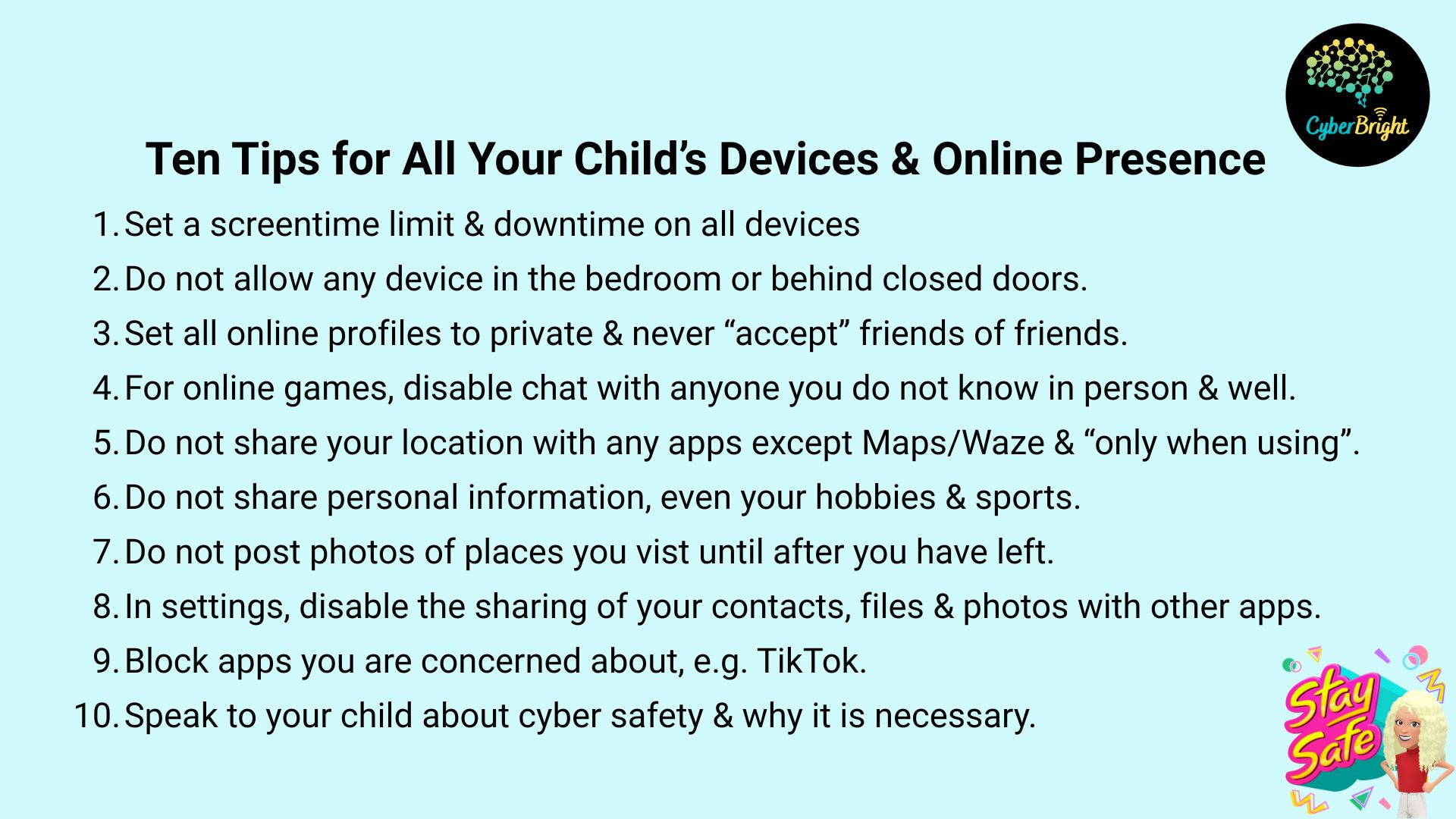
Drawing from my own screen-time rules, which have morphed over the years from allowing certain cartoons on Apple TV or NickJr and Disney movies on DVDs, to safeguarding my children’s current online exposure as best as possible, and of course pulling from my mentors at CyberSafeKids, I do have ten tips to get you started. (see attached)

The truth is, even the rules and parameters that I place on myself have changed, as each day I am still learning more ways to safeguard myself, my family and my friends. And while it is imperative for me to protect my own children, there is an overwhelming need for all children to be protected online. For those of us who can be a part of this, we must do so. For this to be effective in every way, all adults need to learn about cyber safety. If we want children to buy into the idea that cyber safety is essential, adults have to buy into the same. In order for all adults to get on board, clear and stringent cyber safety laws should be put in place here in Jamaica. While there is a supposed to be a National Child Online Protection Committee, I do feel very strongly that there should be a specific “Child’s Right to Online Safety” Act. That said, for this to be executed and enforced, cyber safety awareness must be simultaneously brought to all Jamaicans through our education system and through media in a collaborative effort. So, a big shout out and my gratitude to Sunrise CVMTV for beginning to get on board with me at CyberBright.

Stay Sharp and #BeCyberBright.

emma@becyberbright.com
Share this:

  • Click to share on X (Opens in new window) X
  • Click to share on Facebook (Opens in new window) Facebook
  • Click to email a link to a friend (Opens in new window) Email
  • Click to print (Opens in new window) Print
  • Click to share on LinkedIn (Opens in new window) LinkedIn
  • Click to share on Reddit (Opens in new window) Reddit
  • Click to share on Tumblr (Opens in new window) Tumblr
  • Click to share on Pinterest (Opens in new window) Pinterest
  • Click to share on Pocket (Opens in new window) Pocket
Like Loading...

Care What You Share: Be CyberBright about Sharing Personal Information & Location

11 Sunday May 2025

Posted by becyberbright in Life

≈ Leave a comment

Tags

parenting, social-media, technology

Too often we easily share our personal information online – the sports in which we participate, the football clubs we support, our hobbies, our trips, our dreams and even information about our children. We might not explicitly write what any of these are, but by posting photos, we are revealing so much about our lives. Even if our social media accounts, like Instagram, are set to private, any number of our friends or followers could screenshot a photo and share with whomever they please. If you have 500 followers, all 500 of them could potentially screenshot and share your photos. But the truth is, it only takes one follower to do this and then it’s out of even their control. Who is to say with whom they will share and with whom the next person will share, and so on?!

Can you imagine if you printed out each of your photos you have ever posted on Instagram, as a post or a story, 500 times and handed each photo to 500 people Down Town, or anywhere for that matter! These 500 people would think you were very strange for doing this and, frankly, the whole exercise would seem rather creepy. It would also be highly unlikely for any of these 500 people to make copies of your photos and hand them out to others. So, why are we comfortable sharing the same photos with the 500 followers online? Please take note: Online life is real life on steroids.

Let’s now look at location sharing.

Apps and websites often ask us, in the form of a pop-up box, if we would like to share our location. It happens so fast that it is very easy to “allow”, especially as we may be focusing our attention on what we want or need from the app or website itself, thus not reading the pop-up box properly and clicking on it just to eliminate it from our screen. You know it happens! In fact, some people think that sharing location is harmless and may have benefits.

Teenagers are especially prone to easily sharing their location. Take Snapchat, for example, which has Snap Map. “Snap Map lets you discover fun places, see what your friends are up to, and view Snaps from the community.” https://help.snapchat.com/hc/en-us/sections/5689786363284-Snap-Map If you choose to share your location, this information is also revealed about you to all your “friends” on Snapchat. Once again, your “friends” can screenshot your location and share with whomever they choose. Moreover, you may not actually know all your “friends”. It is quite common for teenagers to allow “friends” of “friends” to follow them. It is also quite common for none of them to know who indeed some of these “friends” of “friends” are, no matter how far back they might try to trace them. In reality, these “friends” of “friends” are in fact strangers, potentially predators.

Your teenager is out with his or her friends at the movies, followed by dinner in the food court, let’s say. Everyone, except your teen, wants to go to the ATM and your child agrees to watch their backpacks while they go for cash. Minutes later, someone comes up to your child and introduces himself as “Michael”, explaining that he is a friend of some of the close friends in the group. He says he was supposed to meet them for dinner after the movies, he names the friends, he indicates where they all go to school and live, what mode of transport they take, where each friends went yesterday, last weekend, and so much detailed information about their movements over the last few months, or even year, that your child has enough proof that Michael is legitimately a close friend of some of the friend group. Michael gets a phone call, then tells your teen that one of the friends, Peter, at the ATM, is asking them to bring their bags up to the carpark. Off your teenager goes to the carpark, with Michael and all the bags, to meet Peter and the others. They get to the carpark, “Michael” has a gang waiting for your child, from whom they and Michael steal all the bags, along with your child’s phone and wallet. Predators will go to great lengths to learn yours and your friends’ patterns online. Snap Map facilitates this predatory behaviour.

The truth is, it is not a necessity to share your location online. Now, you may need it when using Google Maps or Waze, but ensure that in your phone settings you select “only while using”, then properly scroll out of said app as soon as you have finished using it. You may even have an app like Life360 with your immediate family, but make sure you are only sharing your location with said immediate family. Otherwise, why do you need to share your location? You do not. Stay Sharp. #BeCyberBright

emma@becyberbright.com

Share this:

  • Click to share on X (Opens in new window) X
  • Click to share on Facebook (Opens in new window) Facebook
  • Click to email a link to a friend (Opens in new window) Email
  • Click to print (Opens in new window) Print
  • Click to share on LinkedIn (Opens in new window) LinkedIn
  • Click to share on Reddit (Opens in new window) Reddit
  • Click to share on Tumblr (Opens in new window) Tumblr
  • Click to share on Pinterest (Opens in new window) Pinterest
  • Click to share on Pocket (Opens in new window) Pocket
Like Loading...

Subscribe

  • Entries (RSS)
  • Comments (RSS)

Archives

  • May 2025
  • April 2025
  • November 2024
  • October 2024
  • September 2024
  • May 2023
  • April 2023
  • January 2023
  • November 2022
  • April 2022
  • March 2022
  • February 2022
  • November 2021
  • October 2021
  • March 2021
  • September 2020
  • June 2020
  • May 2020
  • April 2020
  • March 2020
  • February 2020
  • January 2020
  • November 2019
  • April 2019
  • March 2019
  • December 2017
  • November 2017
  • October 2017
  • September 2017
  • August 2017
  • July 2017
  • June 2017
  • May 2017
  • March 2017
  • February 2017
  • January 2017
  • October 2016
  • September 2016
  • June 2016
  • May 2016
  • April 2016
  • March 2016
  • February 2016
  • January 2016
  • December 2015
  • November 2015
  • October 2015

Categories

  • Children
  • Education
  • Fashion
  • Food
  • Health
  • Humour
  • Life
  • Uncategorized

Meta

  • Create account
  • Log in

Blog at WordPress.com.

  • Subscribe Subscribed
    • CyberBright
    • Join 64 other subscribers
    • Already have a WordPress.com account? Log in now.
    • CyberBright
    • Subscribe Subscribed
    • Sign up
    • Log in
    • Report this content
    • View site in Reader
    • Manage subscriptions
    • Collapse this bar
 

Loading Comments...
 

    %d