• Stay Sharp. Be Cyber Bright.
  • https://www.youtube.com/@becyberbright
  • https://www.cybersafekids.ie/online-safety-jamaican-style/

CyberBright

~ Navigate Cyber Space in a Smart Way. Stay Sharp. Be CyberBright. Cyber Safety is a Human Right. You'll also find my ServeYouWrite blog entries: Health, Adventure, Travel, Humour, Food, Philosophy, Books & More!

CyberBright

Tag Archives: Cyber Safety

A Child’s Right to Online (Cyber) Safety. Stay Sharp. Be CyberBright.

21 Wednesday May 2025

Posted by becyberbright in Life

≈ Leave a comment

Tags

becyberbright, Children, Cyber Safety, Education, mental-health, parenting, social-media, technology

“Your child does NOT have the right to be fed, clothed, housed and educated, nor does your child have the right to safety,” said no-one!

What if parents agreed with this notion, however? You would be appalled, correct?

How many of you parents make it your business to keep your child safe online at all times? How many of you have put in parental controls limiting device-use time and setting “downtime” hours on all devices, as well as blocking certain apps or limiting time spent on particular apps? Have you talked to your children about the potential dangers they might face online? Does your child share his or her location with any app or website? Is your child’s phone/device contact list shared with apps such as Instagram or Snapchat? What personal information does your child share on their social media platforms? Does your child share hobbies or the sports played, the school he or she attends, photos of your house, or even where your family is currently on vacation? Have you vetted every single one of their “friends” or followers online? Do you allow your child to play online games with people they have never actually met in person? Does the online game, which your child is playing, facilitate chatting with strangers, text or voice, and have you put the settings to disable this feature? Does your child go on YouTube? Do you know the content of every single video your child has watched or is watching? Does your child ever watch TikTok reels or videos? Are you aware of the content TikTok feeds to your child in the “suggested for you” feed? Have you read RTÉ Prime Time Experiment reveals disturbing content recommended to 13 year old Tik Tok users? Do you check your child’s phone regularly to ensure that he or she is not exposed to any inappropriate content, via any website or app, including communication with people he or she does know? Do you allow your child to take his or her device into a bedroom or private space with the door closed? Do you allow your child to have any device in the bedroom overnight?

If you read the United Nations Convention on the Rights of Children, which contains 54 Articles in total, you will find several Articles that could arguably include a child’s right to cyber safety (online safety). Article 17, in particular, bears the language that puts the onus on us, as the adults, to ensure that the information children get online is not harmful. “Children have the right to get information from the Internet, radio, television, newspapers, books and other sources. Adults should make sure the information they are getting is not harmful. Governments should encourage the media to share information from lots of different sources, in languages that all children can understand.” Convention on the Rights of Children – Child Friendly Version

In Article 34 of the aforementioned, it explicitly insists “The government should protect children from sexual exploitation (being taken advantage of) and sexual abuse, including by people forcing children to have sex for money, or making sexual pictures or films of them.”

Surely children should equally be protected from online sexual exploitation, such as cyber grooming, both by strangers and people they know.

Oh, wait! The Convention on the Rights of Children – Child Friendly Version does technically have a blanket cover for every single form of exploitation, as depicted in Article 38: “Children have the right to be protected from all other kinds of exploitation (being taken advantage of), even if these are not specifically mentioned in this Convention.”

I know that this all sounds incredibly daunting and time consuming. How on earth are we, as parents, expected to monitor our child’s every move online? Don’t you know we have jobs and homes to look after? We have to worry about feeding our families and paying the bills, as well as ensuring that our children do their homework. Simply put, we are not with our children 24 hours a day. This, however, does not exempt us from the obvious responsibility, in all matters, which we have for our children, whose lives are very much entwined with the online world. Thus, we must make every effort to set aside the time to educate ourselves and put parameters in place when it comes to our children’s online presence. Remember if your child has access to the world online, then the world has access to your child. The cyber world is not a game of “let’s play pretend”, but rather, real life on steroids. Within seconds, a message, a post, an image or a video can be shared and go viral, or within minutes your child could be exposed to inappropriate content and exploitation.

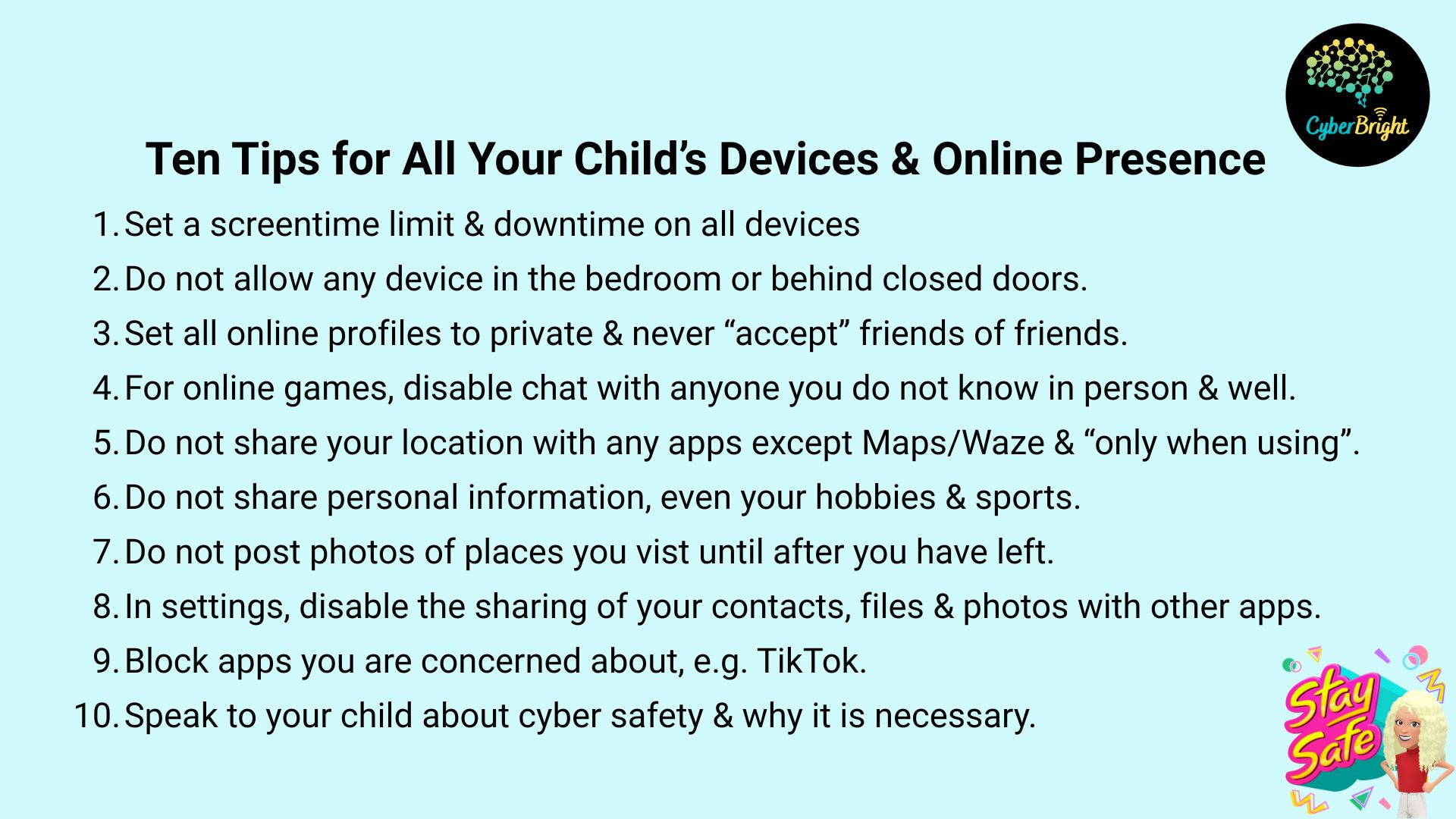
Drawing from my own screen-time rules, which have morphed over the years from allowing certain cartoons on Apple TV or NickJr and Disney movies on DVDs, to safeguarding my children’s current online exposure as best as possible, and of course pulling from my mentors at CyberSafeKids, I do have ten tips to get you started. (see attached)

The truth is, even the rules and parameters that I place on myself have changed, as each day I am still learning more ways to safeguard myself, my family and my friends. And while it is imperative for me to protect my own children, there is an overwhelming need for all children to be protected online. For those of us who can be a part of this, we must do so. For this to be effective in every way, all adults need to learn about cyber safety. If we want children to buy into the idea that cyber safety is essential, adults have to buy into the same. In order for all adults to get on board, clear and stringent cyber safety laws should be put in place here in Jamaica. While there is a supposed to be a National Child Online Protection Committee, I do feel very strongly that there should be a specific “Child’s Right to Online Safety” Act. That said, for this to be executed and enforced, cyber safety awareness must be simultaneously brought to all Jamaicans through our education system and through media in a collaborative effort. So, a big shout out and my gratitude to Sunrise CVMTV for beginning to get on board with me at CyberBright.

Stay Sharp and #BeCyberBright.

emma@becyberbright.com
Share this:

  • Click to share on X (Opens in new window) X
  • Click to share on Facebook (Opens in new window) Facebook
  • Click to email a link to a friend (Opens in new window) Email
  • Click to print (Opens in new window) Print
  • Click to share on LinkedIn (Opens in new window) LinkedIn
  • Click to share on Reddit (Opens in new window) Reddit
  • Click to share on Tumblr (Opens in new window) Tumblr
  • Click to share on Pinterest (Opens in new window) Pinterest
  • Click to share on Pocket (Opens in new window) Pocket
Like Loading...

Stay Sharp. Be Cyber Bright.

21 Monday Apr 2025

Posted by becyberbright in Life

≈ 2 Comments

Tags

Children, Cyber Safety, cyber-bullying, cyber-grooming, Education, jamaica, mental-health, online, schools, sextortion, well-being

Imagine your 12 year old daughter committing suicide because she had been sexually abused and blackmailed by a man who had catfished her, originally pretending he was a girl her age named ‘Sarah’. This is what happened in 2018 to 12 year old American, Cimarron Thomas, who lived with her parents and siblings.

“Using a fake persona, (Alexander) McCartney contacted her (Cimarron Thomas) online, complimented her on her appearance, and began grooming her before she sent him an intimate photo. The court heard that during the first abusive interaction, he kept her online for an hour and 45 minutes, demanding sexual and degrading images. He told her if she didn’t send him more photos, he’d publish the ones he already had on the internet. Cimarron went back to school and did not tell anyone about the abuse. McCartney continued to pursue Cimarron and contacted her four days later using another fake account, saying: “I want to play one more time.” Despite pleading for McCartney to stop and being visibly upset, he told her to “dry your eyes” and involve her younger sister, aged nine, in a sex act. Cimarron refused and said she would rather kill herself. McCartney then put up a countdown clock, telling her “goodbye and good luck”. Three minutes later, Cimarron was found by her nine-year-old sister, who entered the room after she thought she heard a balloon pop. She had shot herself in the head with the family’s legally-held firearm. Cimarron was taken to hospital where she was pronounced dead. Her family had no idea why she had taken her life and were unaware of the ordeal she had been subjected to. Her mother, Stephanie, told investigators that she might have been unsure of her sexuality. Eighteen months later, Cimarron’s father then took his own life. However, years later, the truth behind what had happened to Cimarron emerged.” https://www.bbc.com/news/articles/cm2yj24xge1o

Thanks to the bravery of a 13 year old girl from Scotland, who spoke up after being catfished by the same university student, Alexander McCartney, authorities were able to capture, arrest, convict and jail him for at least 20 years.

“Alexander McCartney from Northern Ireland pretended to be a teenage girl to befriend, then abuse and blackmail children around the world, often sharing images with other paedophiles. Some of the children were as young as four. Some had never told anyone what they had been through – until police knocked on their door. McCartney gradually admitted 185 charges including manslaughter after a 12-year-old girl he was abusing took her own life.” https://www.bbc.com/news/articles/crejr8grr01o

As if the thought is too much to stomach, and I apologise to anyone who may be triggered by these harrowing facts, I believe it is imperative that all parents read about and pay attention to the horrors happening across the world and understand that our children are not necessarily safe in their bedrooms on their devices – phones, laptops, iPads and any other electronic tablets/devices that can be connected to the internet.

“McCartney’s crimes occurred between 2014 and 2019, when he’s believed by police to have targeted about 3,500 victims, mostly via Snapchat, all over the world, including in Australia, New Zealand and the U.S., according to the Press Association. The case against him in the Belfast Crown Court focused on 70 child victims, including (Cimarron) Thomas.” https://www.cbsnews.com/news/catfishing-alexander-maccartney-sentenced-us-girl-cimarron-thomas-suicide/

Young girls are not the only demographic at risk – our boys are being targeted as well, notably through ‘sextortion’ by online criminals pretending to be pretty young girls attracted to them. Three particular cases, which have been in the media in the USA, come to mind. These involve 15 year old Braden Markus, who died by suicide in 2021 within 30 minutes of being ‘sextorted’ online, and James Woods and Jordon DeMay, both 17 years olds when they each committed suicide in 2022, also after being ‘sextorted’.

“When police looked through James’ phone, they discovered he had fallen victim to financial sextortion, a crime that occurs when a predator threatens to distribute private material or harm a victim if they don’t comply with the predator’s financial demands. The scam is the fastest-growing cybercrime targeting children in North America and most commonly exploits young men, particularly boys ages 13 to 17. Sextortion has been connected to at least 30 deaths of teen boys by suicide since 2021, according to a tally of private cases and the latest FBI numbers from cybersecurity experts………The teenage girl who messaged him (Jordan DeMay) was really a group of cybercriminals that included Samuel Ogoshi and Samson Ogoshi, Nigerian brothers who in September 2024 were sentenced to 17½ years in prison and extradited to the U.S. The group of predators targeted Jordan and more than 100 others, including at least 11 minors.” https://www.usatoday.com/story/life/health-wellness/2025/02/25/teenage-boys-mental-health-suicide-sextortion-scams/78258882007/

The truth is, even people whom our children and we know can become predators in the form of scamming or sexual grooming. That said, there are many wonderful and fun aspects of the internet that have become daily common-use and necessary for work, learning, socialising and gaming for adults and children alike.

Most people do not realise the real dangers of privacy invasion and scams, which can lead to compromising your WhatsApp messages, the contacts stored in your phone, your personal and business files, your bank account information, and even access to your online shopping sites such as Amazon and other apps where money is at stake. Moreover, the risks posed by believing and further spreading fake news, as well as inappropriate content exposure, sexual grooming, sexual harassment and other acts of cyberbullying can affect all ages, including adults. Many children, especially teenagers, have little to no cyber-supervision and the adults in children’s lives don’t fully understand the extent to which they could fall prey because they, the adults, are also victims of online manipulation and abuse. 

Moreover, we can pay a high price when it comes to our digital footprint, as every time we post anything online, it becomes part of our digital footprint. Everything we do online stays online forever. If we delete it, someone could have screenshot and saved it already. Every “like”, comment, search, video watched, music listened to, and so on, all leave a digital footprint. What we do online today can affect our current positions at work and any job applications in the future. Our digital footprint must be a positive one.

Children must especially take note as schools, colleges and universities all look for social media presence of their applicants. Your past can come back to haunt you, so unless would not have a problem if something you have posted/commented on/done online were to be published on the front page of the newspaper, do not do it. Not to say you’d want what you share/post to be published in the paper, but you must be okay with it if it is. Like I tell the teenagers and young children to whom I give cyber safety workshops, “The online world is the real world on steroids.”

Which leads me to the cyber safety workshops themselves. In 2020, soon after the Covid pandemic began, I was trained as a trainer in Cyber safety by CyberSafe Ireland, now called CyberSafe Kids, https://www.cybersafekids.ie/, after which I designed an interactive Cyber Safety programme to help students, their teachers and their parents. I launched my online Cyber Safety workshops in April 2021 and by October 2021, I had reached 1400 students, teachers and parents from rural community schools in Westmoreland, Hanover and St. Mary in Jamaica.

After a long hiatus doing other projects, I saw that the need for literacy in social media and online use in general was rising exponentially, so I relaunched my cyber safety programme under the name CyberBright. In May 2024, I brought my workshops to 700 students in 21 class groups at Campion College and in February/March 2025, I taught another 550 students in 19 class groups at Campion. In September 2024, I also gave a workshop to students of Ph.D. Clinical Psychologist Dr. Tracey-Ann Coley doing their Masters in Psychology at University of the West Indies, so they might be able to use the knowledge about the online social risks to which children are exposed in order to help them.

My Ikigai (my purpose) is to bring Cyber Safety to everyone in Jamaica. While I think that it is a necessity to have Cyber Safety in the core of the curriculum within primary and secondary schools, I do understand this is a task which I cannot tackle alone. The efforts must be collective, beginning with the Ministry of Education and tertiary institutions, which would need to provide training for the teachers/trainers. In the meantime, I believe media is the best way to get this message out to the public: It is imperative for children and adults to learn how to navigate the cyber space in a safe and smart way. We need to stay Sharp and be CyberBright.

Please contact me at emmasharptv@gmail.com if you have any questions about cyber safety, would like me to conduct cyber safety workshops for you or are interested in collaborating to help all Jamaicans become socially cyber safe.

Share this:

  • Click to share on X (Opens in new window) X
  • Click to share on Facebook (Opens in new window) Facebook
  • Click to email a link to a friend (Opens in new window) Email
  • Click to print (Opens in new window) Print
  • Click to share on LinkedIn (Opens in new window) LinkedIn
  • Click to share on Reddit (Opens in new window) Reddit
  • Click to share on Tumblr (Opens in new window) Tumblr
  • Click to share on Pinterest (Opens in new window) Pinterest
  • Click to share on Pocket (Opens in new window) Pocket
Like Loading...

How about a ‘NO’ to sharing the foolishness!

16 Tuesday Nov 2021

Posted by becyberbright in Life

≈ 2 Comments

Tags

Cyber Safety, Online Safety

Have you ever seen those quizzes on social media – the ones that ask you a bunch of seemingly lighthearted questions? “What was the name of your favourite teacher?”; “What was the first city you lived in?”; “What’s your favourite meal?” OR you see a post that says, “Your stage name is a combination of the name of your first pet and your grandmother’s maiden name.” Thousands of people across the globe give their answers for thousands more people to see. What’s worrying is that the intention, which is behind asking these questions to the unsuspecting public, is less than innocent and lighthearted.

While I was teaching one of my cyber safety classes the other day, someone admitted that he had received a message on social media offering him money to answer a bunch of questions. The only catch was that he had to give his bank details, in order to get paid. He was a teenager without his own bank account, so he decided to go ahead and give one of his parent’s bank details, along with all his answers to the quiz. Guess what?! He actually got paid. Pretty cool, eh?!

NO. NO. NO. NOT COOL AT ALL. This is one of many online scams.

Here is what actually happens. The person behind the scam takes those bank details, along with your answers, and then calls your bank pretending to be you. This person has all those answers to the frivolous questions, remember! These are typically the very security questions that banks ask us, in order to prove we are indeed who we say we are. So why would the scammer bother giving you a little money in the first place? Well, it locks you into a false sense of security – the offer must be legit! What do you do when you believe an offer is real? You post it on your social media pages and you pass it on to all your contacts in your phone. You are serving the scammer so well that you don’t even realise you’re essentially helping the scammer to scam hundreds of other people, or more, as the chain will simply keep going and going.

What about when you are signing up for a new online account? What details do you give? Your email, your phone number, or a third party account with which to sign in? With these options available, which sounds safer? The third party sign in option is usually with your Facebook or Google account. Sounds pretty simple. You won’t have to give out your email, nor phone number, and you won’t have yet another username and password to remember. Before you know it, you are signing in to all these wonderfully useful platforms through your Facebook and/or Google accounts. What a breeze, eh?!

NO. NO. NO. NOT A BREEZE AT ALL. You have now connected all your new accounts to the big accounts you depend on for many of your online needs.

Has your Instagram account ever been hacked? You couldn’t get into it because someone literally took it over? It’s concerning, of course, but at least it’s only one account. But is it only one account? NO.

Instagram, WhatsApp and Facebook are all owned by the same people. These are connected. Remember you have been signing into all those other online accounts through your Facebook login? Now someone has hacked into your Instagram. So, what do you think the potential outcome of this could be? NOT GOOD.

If this does happen to you, go into your Facebook account immediately and change the password in settings (How to keep your account secure). Go into every single one of your other settings and make everything private, or choose the “Only Me” option. Ensure that you go into data settings and remove every app and website, which you’ve signed in with Facebook, or any that you have recently used. Just delete all of them. To be on the safe side, go into your Google account and change your password. If any family member’s account is connected to yours, change those passwords as well. Pick passwords that are long phrases, which are easy for you to remember, but ensure you use a combination of lowercase and uppercase letters, as well as numbers and symbols.

There are countless more ways in which people online can trick us all. We must each be vigilant and, when we see offers, ask ourselves if we know the person or company that is making the offer. Scams are vague and usually get passed down through a long chain of ‘forwards’. Scams do not identify with a reputable and known company. If it looks too good to be true, it probably is. If it looks like a fun and frivolous questionnaire, seemingly harmless, it is HARMFUL. Don’t let these scammers take you for a fool. Don’t participate in these scams. Don’t ‘share’ these scams. How about a ‘NO’ to sharing the foolishness.

Share this:

  • Click to share on X (Opens in new window) X
  • Click to share on Facebook (Opens in new window) Facebook
  • Click to email a link to a friend (Opens in new window) Email
  • Click to print (Opens in new window) Print
  • Click to share on LinkedIn (Opens in new window) LinkedIn
  • Click to share on Reddit (Opens in new window) Reddit
  • Click to share on Tumblr (Opens in new window) Tumblr
  • Click to share on Pinterest (Opens in new window) Pinterest
  • Click to share on Pocket (Opens in new window) Pocket
Like Loading...

Subscribe

  • Entries (RSS)
  • Comments (RSS)

Archives

  • May 2025
  • April 2025
  • November 2024
  • October 2024
  • September 2024
  • May 2023
  • April 2023
  • January 2023
  • November 2022
  • April 2022
  • March 2022
  • February 2022
  • November 2021
  • October 2021
  • March 2021
  • September 2020
  • June 2020
  • May 2020
  • April 2020
  • March 2020
  • February 2020
  • January 2020
  • November 2019
  • April 2019
  • March 2019
  • December 2017
  • November 2017
  • October 2017
  • September 2017
  • August 2017
  • July 2017
  • June 2017
  • May 2017
  • March 2017
  • February 2017
  • January 2017
  • October 2016
  • September 2016
  • June 2016
  • May 2016
  • April 2016
  • March 2016
  • February 2016
  • January 2016
  • December 2015
  • November 2015
  • October 2015

Categories

  • Children
  • Education
  • Fashion
  • Food
  • Health
  • Humour
  • Life
  • Uncategorized

Meta

  • Create account
  • Log in

Blog at WordPress.com.

  • Subscribe Subscribed
    • CyberBright
    • Join 64 other subscribers
    • Already have a WordPress.com account? Log in now.
    • CyberBright
    • Subscribe Subscribed
    • Sign up
    • Log in
    • Report this content
    • View site in Reader
    • Manage subscriptions
    • Collapse this bar
 

Loading Comments...
 

    %d